The architecture, engineering, and construction (AEC) industry is one of the largest consumers of raw materials worldwide and a major contributor to waste and greenhouse gas emissions. Moving toward a Circular Economy (CE) where waste is eliminated, materials are reused, and natural systems are regenerated — is critical. However, the shift from today’s linear “take–make–dispose” model is slowed by the industry’s fragmented and complex data landscape.
This is where Large Language Models (LLMs) come in. With their proven ability to interpret unstructured and diverse data, LLMs are becoming pivotal tools in advancing both Lifecycle Assessment (LCA) and CE practices in construction.
Turning Unstructured Data into Circular Insights
Circularity practices remain only partially adopted across many regions. For instance, a 2025 study of AEC firms in East Java, Indonesia, shows that CE implementation is moderate, with most practices scoring only 2.5–3.5 out of 5. The most commonly applied strategies include modular and prefabricated construction, usage of ecological materials in design, Building Information Modeling (BIM), strategic waste prevention planning, and selecting durable, non-toxic, reusable materials (Hendrianto et al., 2025).
Despite this, much valuable information remains locked within unstructured sources. LLMs can scan and make sense of these by identifying data about material flows, embodied carbon, and reuse potential. They can then present these details in accessible formats, like structured dashboards or interactive queries dramatically improving traceability and lifecycle planning. This enhanced clarity helps close material loops and drives circularity.
Navigating Challenges and Enablers of CE
Awareness of CE in mega-projects is growing, yet knowledge remains uneven across lifecycles. A qualitative study of three Saudi mega-projects found that most professionals focused on reuse, recycling, and waste reduction, but deeper lifecycle circularity insights were lacking. The key enables broader adoption.
- Regulatory frameworks that mandate or incentivize circular practices
- Enhanced professional awareness and education
- Adoption of advanced technologies
- A mature secondary materials market
- Policy support for CE initiatives
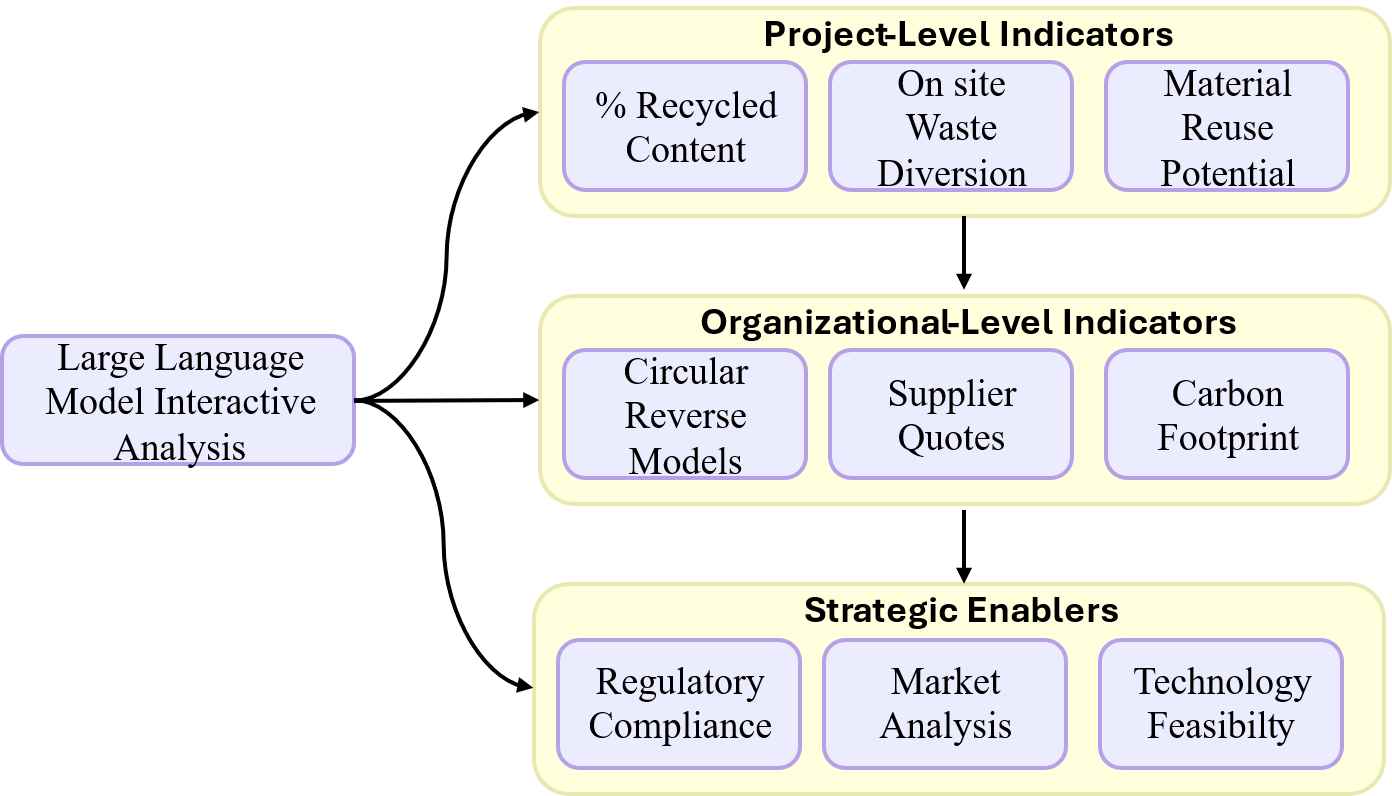
Saudi initiatives like Vision 2030 — with its “Giga Projects” such as NEOM — also heighten the need for sustainable construction. The country’s construction contributes around 6% of GDP and creates millions of jobs, yet less than 14% of construction waste is recycled. In this context, LLMs can help stakeholders grasp policy complexity, track emerging technologies, and evaluate market readiness for (Alotaibi et al., 2024).
Building Holistic CE Assessment Frameworks
For construction organizations to measure circularity effectively, robust assessment frameworks are needed. LLMs can review standards and literature to identify and prioritize multi-level CE indicators . These range from project-specific metrics like percentage of recycled aggregates used to organization-wide goals such as reduction in virgin material procurement.
This approach aligns with calls for systematic CE assessment at both project and organizational levels (Jayakodi et al., 2024) and reflects the evolving scientific understanding of CE in construction (Norouzi et al., 2021).
By turning unstructured data into actionable insights, LLMs are not just technical tools they are catalysts for a more circular, sustainable, and resilient construction industry.
Article by
Nada ElDesouky
Nada Salah ElDesouky is a Teaching Assistant at the British University in Egypt (BUE). She earned her Bachelor’s degree in Construction and Building Engineering from the Arab Academy for Science, Technology and Maritime Transport (AASTMT) in 2021, where she is currently pursuing her Master’s degree. Her research centers on applying computer vision to construction engineering, with a strong interest in leveraging Artificial Intelligence and Large Language Models (LLMs).


admin