Nowadays, the construction sector plays a paramount role in economic development worldwide. However, this has also made the construction and building industries major contributors to global carbon emissions. Consequently, many developed and developing countries have adopted sustainable tools, such as Life Cycle Assessment (LCA), to evaluate the environmental impacts of construction projects. By contrast, Egypt remains in the early stages of applying these tools within its construction and building industries.
For Egypt to adopt sustainable construction, more studies are needed that focus on sustainable applications and tools to ensure better implementation of environmental measures. This study attempts to assess and quantify the environmental impact of construction materials used in an industrial building, specifically, a plastic production factory located in 10th of Ramadan City, Egypt. The project covers a land area of 13,600 m², with a total built-up area distributed across four levels: basement, ground floor, mezzanine, and first floor.
From Concept to Implementation
This research study was guided by several objectives, which can be summarized as follows: (1) to develop a simplified procedure in OneClick for assessing the environmental impact of structural construction materials, (2) to evaluate the environmental impact of construction materials for an industrial building in Egypt, (3) to propose sustainable alternatives for reducing the environmental impact of construction materials, and (4) to analyze and report the social cost of carbon emissions for different sustainable alternatives.
The project required a significant amount of resources, including 13,521 m³ of concrete and 1,290 tons of steel across all structural elements. Subsequently, the environmental effects of these materials were assessed and analyzed using OneClick LCA. These impacts included carbon emissions as well as other sustainability-related parameters, such as carbonization, energy consumption, water demand, building service life, and gross internal floor area.
The Carbon Cost of Construction
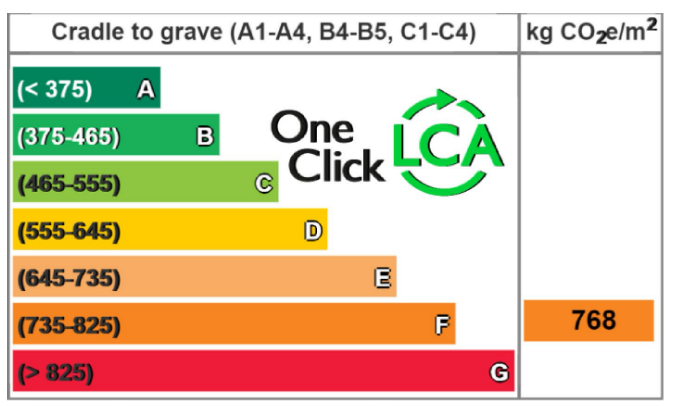
The total carbon dioxide equivalent emissions (CO₂e) of the project amounted to 29,122 tons, translating to 132.98 kg CO₂e per square meter per year. When translated into monetary terms using the social cost of carbon, the project’s impact reached €1,456,090.
The analysis revealed that the A1–A3 stages (raw material extraction, processing, and manufacturing) accounted for 94% of the total embodied carbon, while transportation and disposal phases contributed less than 10%. This aligned with global research findings that concrete and steel production are among the most carbon-intensive phases of construction.
Exploring Sustainable Alternatives
Effectively reducing emissions requires integrating sustainability considerations at the early design stage, when decisions have the greatest potential impact. In this study, several alternatives were tested against the baseline case, which relied on 0% recycled content in concrete and steel and produced the highest emissions.
One of the alternatives required progressively increasing recycled binders (40–55%) and recycled steel (up to 97%). This option delivered the best results, cutting emissions to 24,435 tons CO₂e and reducing the social carbon cost to €1,221,749.
Moving Toward Low-Carbon Building Practices
This case study provides several important findings for both Egyptian and global practitioners. First, it highlights the critical role of digital tools like OneClick LCA in making environmental impacts measurable and quantifiable. Second, it underscores the potential of relatively simple interventions, such as using recycled content in binders and steel, to achieve measurable reductions in embodied carbon. Finally, it demonstrates the importance of proposing and testing alternatives at the design stage, where decisions have the greatest potential to decarbonize industrial buildings.
Importantly, this study shows that LCA can be an effective and reliable sustainable tool in the building and construction industries in Egypt. By integrating LCA early in design and procurement, practitioners and stakeholders can make informed decisions that balance cost, performance, and environmental responsibility. It may be concluded that the construction and building industries in Egypt are in need to adopt existing LCA tools during the design development stage as a decision aiding tool for better enhancement of sustainability of construction industry.
Article by:
Berlant Arab
M.Sc Graduate, Research and Teaching Assistant, Department of Construction Engineering, The American University in Cairo (AUC), Cairo, Egypt.
berlantarab@aucegypt.edu
Mohamed Abdel Raouf
Assistant Professor, Dept. of Construction Management and Interior Design, Ball State University, Muncie, IN 47306, USA.
maraouf@bsu.edu


admin